Storytelling Arts' mission is to preserve, promote and impart the art of storytelling to develop literacy, strengthen communities and nurture the human spirit.
Showing posts with label storyteller. Show all posts

Friday, October 18, 2013

Girl Power: Notes from the field


By Luray Gross and Maria LoBiondo - Storytellers for Girl Power! held during the KidsBridge to the Arts Camp 2013


One of the Girl's collage's exploring themes in “Tipingee”


The girls slouched on couches in a half-circle near the end of a very busy day packed with theater, dance, choir, songwriting, and visual art. It was day two of Kids Bridge to the Arts Summer Camp, and energy was low. 

            Then one of our nine middle schoolers asked, “Why is this called ‘Girl Power’?”

            “Where is your power?” we countered.

The girls perked up.  Once the conversation on respect and self-empowerment started, their ideas flowed. Physical power was mentioned first, but then came the power of our words, the ability to take control of a situation, being thoughtful. This was the perfect lead in to writing personal poems that reflected what each girl thought about themselves.
 
            Describing herself as the element of water, one girl wrote: “I would be snow so that I can cover bad things. Then I melt and they are carried away.” Another wrote, My body is a temple…. Even when it is insulted, it stands strong always.”

The discussion about power also related to the story we would work on for the rest of the week: the folktale “Tipingee.” This story, published by Diane Wolkstein in her classic collection of Haitian folktales, The Magic Orange Tree, revolves around how spunky, savvy Tipingee, along the help of her friends, saves herself from being taken away by a stranger to be his servant. 

            It had quickly come to mind when we were choosing a story for a group of middle-school girls to hear, explore, play around with, internalize, and – ultimately – present for an audience of fellow campers (ages 6 – 13), teen counselors, and an assorted crowd of parents, grandparents, and other supportive adults.

             We wanted a story in which a girl, facing difficulty, takes charge of her fate, and a story that emphasized the role of young people helping each other. Our time would be quite limited, so we needed a story with mnemonic devices and a plot that would not be difficult to learn. Like many Haitian tales, “Tipingee” includes three nearly identical mini-episodes and a chant which listeners are encouraged to repeat. Overall, we wanted a story the girls could have fun with. We were, after all, planning for summer camp, not the heart of an academic program.

             We explored “Tipingee” through collage and journal writing as well as discussion. The girls keyed in to the emotions and examples of power in the story through both art forms.

            On Thursday, we decided how to divide the story for telling, and one of the girls suggested that her role would be to come up with an introduction. There was just time to try it out and be sure everyone knew where to begin and end. 

             As the hall filled on Friday afternoon, one of our very capable, but also self-conscious girls, came up and announced, “I’m not telling my part.  I can’t, I’m too nervous.”

    “But, Kyara,” we said. “We need you. We need all the parts of the story.”

     “Is everyone else going to do it?”

     “Yes,” we said, counting on no more attempted defections.

     “Okay.”

            Of course, Kyara did not leave her friends in the lurch.
 
        “I’m Tipingee, she’s Tipingee, we’re Tipingee too,” the girls chanted together from their places on the stage at the afternoon showcase, the culmination of the Trenton, NJ, Kids’ Bridge to the Arts Camp 2013. In a week, “our” girls had become a cohesive and powerful group of storytellers. Proud as any parent might be, we watched and listened from the back of the crowded hall.

Thursday, August 29, 2013

Hidden


by Jack McKeon
 
Yesterday (8/16)  Julie DellaTorre and I attended a performance of a play written and acted by Girls Surviving, the program in Morristown that Paula Davidoff has been a guiding part of for years.  It was my second time to watch these girls perform  in the summer program and both times I have been impressed by the cohesion, cooperation and even acting abilities of the girls, who must, at first, show up with all the baggage of  “girls at risk”, and by the sophistication of the ideas explored in the play itself, written through a process of self-exploration and mutual discussion focused on issues of immediate consequence to the girls.

The play was titled “Hidden”.  The concept paired the girls, one as the socialized persona trying to keep to the right path and the other the hidden shadow urging them on to some sort of self-destructive, if immediately pleasurable, behavior.  A second theme was dreams, what they are like, what they can give us or unleash in us, and how we can try to make them real.  The lovely opening put the girls onstage, the hidden self behind the open one.  They began to speak of dreams while performing slow dance movements, hidden interweaving with open.  If these kids got that concept, as they must have, what a wonderful thing for them to experience.

As the play went on, I was struck by the fairy tale concept in it.  It was, in fact, a good representation of the princess/waiting maid conflict in “The Goose Girl”.   I spend much of my storytelling time with this kind of analysis so I was happy to see it open up on stage and, I would think, in the imaginations of the girls.  At one point, one of the girls becomes her Dad’s “princess” and her mother tells her that she will always be close to her daughter’s heart.  It was an impressive parallel to the Grimms’ tale, even after (Duh!) one of the girls during the post performance Q and A mentioned that Paula had told them a story which had influenced the shape of the play.  Of course this was “The Goose Girl”.  Paula, I now remembered, had introduced her wonderful analysis by saying she was going to use it in a situation involving “alter egos”.

What a vivid example of the power of story.  These girls were able to see the patterns of their own lives revealed in the pattern of the story.  They could take that notion, work with it to make it their own and see in it some hope, some indication of the power they have over their own lives.  At the end of the play, the two halves embraced or, hand in hand, opened the door to the future.  In ”The Goose Girl”, the maid and the princess don’t quite make that accommodation, though I believe that the maid’s self-imposed punishment is carried out, perhaps according to her desire, for the good of the whole.  In the Q and A, it became even more clear how these girls, strangers at the beginning, had been drawn together by the experience into a unified, supportive group, a “troupe” as the playbill has it. Even the youngest, an 8th grader, felt accepted and protected by the older girls.  They were sharp, articulate and clearly pleased with what they had accomplished.  The success of the program in general was evident by the number of alumnae there were in the audience.

Having taught high school for many years and worked at the juvenile facilities in Morristown for the past year and a half. I am always curious about what effect we have on the kids we work with.  Sometimes we know, usually we don’t.  However, Julie Pasqual (who also worked this summer in the Girls Surviving program), at the Sussex County fair ran into a boy who was at the detention center when I started with the program.  He recognized her (big surprise there!), was delighted to see her, proud to be out, going for a GED and working.  Julie said he looked like just a kid.  It would be nice to think that his joy at seeing her reflects a little of what we all might be accomplishing, of what storytelling can do.  Maybe you all have many reports of a similar nature. 

Anyway, “Hidden” was a wonderful demonstration of how empowering it can be to tell your story – even if your audience is just a stove. 

Not to put you on the spot, JP, but it would be interesting to know about your experience with the girls.  The joy seems apparent.  What were the difficulties, if any?  And, Paula, if I have misrepresented anything, please comment.

Friday, August 9, 2013


Last week’s post spoke to my participation in a marathon storytelling performance of Monkey: Journey to the West and of the workshops, reading and studying with Diane Wolkstein and colleagues in preparation for our production.

This previous experience made the viewing of Monkey: Journey to the West at Lincoln Center even more enjoyable. Because I was so familiar with the story and the characters, I was able to understand and flesh out parts that may have seemed flat or unclear to others. Just a sentence or two, or a setting or a prop, prompted my memory of the whole episode being portrayed. I was also able to watch with a professional storyteller’s eye. What choices were made with regard to story, episodes, characters, music, movement, colors, costumes and expressions? These were some of the same decisions with which Diane and we grappled.

Here are some of my impressions of the Lincoln Center production Monkey: Journey to the West by the creative team of Chen Shi-Zheng (concept, text and director), Damon Albarn (composer) and Jamie Hewlett (animation and costumes).

THE MULTIMEDIA APPROACH

The production included animation, circus performers, martial arts battles as well as acting and singing. I loved this form. A live orchestra played in the pit, using some traditional Chinese instruments. The music composed for this production added much to the Chinese feel, and the live music brought the animation to a higher level. Although a colleague of mine hated the opening animation scene, I liked it. Hundreds of years passed by very clearly and led seamlessly to the live entrance of Monkey. I was taken right away with the live, loud drumbeats booming as the stone egg bounced off the mountain peaks. (In the Lincoln Center trailer cymbals are used- drums are much more effective.)

The other animated scene that worked well for me was Monkey’s trip to the Undersea Palace of the Dragon King. Again I felt to length of the journey and the depth of the sea. When the scrim lifted to the live scene on stage, I found I was holding my breath as if I were underwater.

I don’t know much about martial arts, but it certainly added to the battle scenes. One tended to meld into another for me, but that’s the same with the hundreds of battle scenes in the novel.

The circus pieces were colorful and fun to watch and though they may have added some to the mood on stage, I don’t think they added much to the story. But I don’t get to see the circus much and loved watching the rope-swingers, fire throwers, acrobats and contortionists. Again, it certainly added to the Chinese feel of the story.

CHARACTERS

I was glad to have spent time exploring the characters in depth before attending this production.

Dear Monkey King was delightful, naughty, audacious, irreverent and exciting. Diane would have loved the portrayal and probably would have ‘lifted’ bits of the performance. However, in the novel, Monkey reaches enlightenment only through much internal struggle and many mistakes, as we all d. At the end of this production Dear Monkey King is made Buddha because he was a great protector of the monk. But throughout the journey in the novel, Monkey grows in self-control, understanding and compassion. This aspect of his character was missing in this production.

The Monk, Tripitaka, was beautifully portrayed. The costume was perfect and the monk appeared calm and serene with much bowing and prostrations, but again I was a bit disappointed. I was able to embellish his shock and disbelief that Dear Monkey King would kill for any reason and then banish him, but the anguish is only hinted at and it is unclear how and why Monkey is forgiven and allowed to return as protector. And where was the trembling and crying? The monk is ALWAYS crying in the novel.

PIGSY was wonderful to see. My friend, Rita, will be happy to see Pigsy here. Diane debated for hours with herself and with others about whether to keep this character or gloss over him. She was still wrestling with this choice the last time I spoke with her.

GUAN YIN was the most unsatisfying portrayal of all. Such an ethereal, compassionate and central character in the novel, here she just floats in and out giving directions. I remember workshops where Joy Kelly (fellow storyteller) led us all, Diane included, in the embodiment of Guan Yin. Joy is the most graceful Guan Yin. We all became better Guan Yins because of her.
 

STORY LINE

Here is where choices become even more important. How does one find the essence of an epic novel and craft it into an understandable and entertaining two hour performance?

OPENING

The opening scenes of the novel are the most well-known part of the story. They stand alone as a complete tale and have been retold in many formats including picture books. Maybe this is why the opening was so easy to follow. As mentioned above, I loved the multi-media approach used in these scenes.

THREE EPISODES

How to choose three episodes out of hundreds, that is the question. Diane Wolkstein was always struggling with this. I was present during many of her performances of this tale and watched her try out one episode or another. The choices portray different inner struggles on the path to enlightenment.

Chen Shi-Zheng chose three episodes in which the heroes confront strong, entrapping women:

·        White Skeleton Woman

·         Spider Woman

·         Princess Iron Fan

 All three episodes incorporated acrobats, circus acts and martial arts battles. Each scene was different and effective; though I’m glad I had some familiarity with the story.

 
ENDING: ACHIEVING ENLIGHTENMENT

The ending here was much too abrupt. Nothing in the preceding performance led to the bestowing of gifts from Buddha. The scene was beautiful and the characters looked so little in front of Buddha, but the story and episodes were nothing more than that, a string of episodes. In the end, the ‘journey’ was not felt.
 

FINAL THOUGHTS

I am so glad I saw this production at Lincoln Center. I wish Diane Wolkstein was here so I could discuss everything with her. I think she would have delighted in the playfulness and experimentation. I think she would have taken insights from the choices made. She would have disregarded what didn’t jive with her understanding of Journey.

I have learned much about myself and about storytelling through my work with Dear Monkey King and my work with Diane Wolkstein and fellow storytellers. There are a few episodes I remember friends performing. I’m going to look those up again right now.

Anyone else see the Lincoln Center production? I’d love to hear your reflections.

Julie DT

Thursday, August 1, 2013


SAI Blog: August 2013


MONKEYING AROUND: PART 1

On Saturday, after storytelling at the Hans Christian Andersen Statue, I took myself to Lincoln Center to see Monkey: Journey to the West. http://monkeyjourneytothewest.com Next week I will give my impressions of the show, but this week I thought I’d give you some background about my interest in the story,  and why I went to see it in the first place.

Jack (fellow SAI teller) and I had the joy and privilege of working with Diane Wolkstein and 23 other storytellers from North America reading, studying and exploring the epic Chinese novel Journey to the West. (We worked with the 4 volume version by Wu Cheg’En and his one volume version, Monkey.)

Diane had been working for years trying to develop an oral retelling of this story and she wanted to see the whole story played out so she planned a marathon telling of the story with 25 storytellers from the US and Canada. The performance took place from Friday night March 18 to Sunday afternoon March 21 2009. In preparation Diane assigned us each multiple chapters which we were to study and pare down to a 10 minute telling. The absolute hardest part was making  the choices of what to include and what to leave out... so much to leave out!

To help us Diane held workshops in which we explored the characters, the essence of the action, the meanings to be found and the language of the text.  We worked on our own selections as well as parts of the whole story. Though most of the work was done on our own, we learned much from our colleagues in these workshops. This knowledge went into our personal tellings.

Diane’s goal was to develop for herself a two hour performance of this story in a clear, concise and entertaining way. Watching her go through the process of developing this piece taught me much about the storytelling choices we make. Having to craft my own 10 minutes was the learning put into practice!

Some of the ‘marathon tellers’ read all 4 volumes, but, probably like most, I read at least huge chunks of the epic novel. And, of course, we all got to see many of the episodes retold by friends and colleagues. The hours spent discussing and analyzing scenes and characters, motivations and symbols, history and sutras led to a deeper understanding of the story. All of this I took to my afternoon journeying with Dear Monkey King at Lincoln Center.

Monday, April 8, 2013

Not just looking, but SEEING


          There is a story that I have long loved to tell.  It concerns a man, in one version he is a prophet, in another he is a magician, who wanders upon a wedding feast. "All are welcome!" cries the father of the bride from the steps of his home.  "Come one, come all!!"  After seeing this, the man goes to his home, and puts on the clothes of a beggar, rubbing dirt and mud on his skin and hair.  Hobbling back to the wedding, he still finds the father of the bride proclaiming that "All are welcome!"  But, when the man in his disguise approaches the wedding hall, he is turned away. 

          The man changes his clothes yet again, but this time he dons the robes of royalty, and this time the father of the bride not only welcomes him in, but bows to him, and allows him to sit at the family table.  During the meal, the man, instead of enjoying the food, puts the food on his clothing - even pouring the wedding wine down the front of his shirt.  All the guests are puzzled by the man's actions, and finally, besides himself with curiosity, the father of the bride asks what the man is doing.  The man looks at the father of the bride and says, "Earlier today, I came dressed as a beggar, and though you said all are welcome, you did not let me in.  Yet, when I came in these rich robes, you treated me as an honored guest.  And so, since I am the same person, and it is only my clothing that has changed, I assumed that what you welcomed in here today was not me, but my garments, and I was simply feeding what you invited into your feast!"

          This notion of being judged by one's appearance is something I think that every human being can relate to, and when I began, through Storytelling Arts, to tell stories in Youth Detention Centers, I found that this story hit home even more deeply.  While I have not yet read the book "Blink", I know it's premise - that we all have "hard wiring" that leads us to make instant decisions about who we think someone is, or is not.  Our past experiences can deeply color what it is we see before us.  And, I have found, while some of that is a good thing, that first glance is not always the whole story, any more than the first line of a folktale is the entire plot.

         In the Detention Centers, it is so easy to be swayed by the physical environment - metal detectors, guards, doors that lock, buzzers, cameras - things that we see in movies and television that project "Danger!!!"  Then there are the young people we are going to see - dressed in identical jumpsuits, walking with their hands behind their backs in a straight line - their faces sometimes stone-like, and hard to read.  If one were to stop at that first assessment, one would RUN - no way storytelling would work here - that's crazy!  But it is then that a teller - that I have learned to take a breath, and really SEE, not just look, but SEE, with more than my eyes, with my guts, with my, for lack of a better word, and not to sound too ooey and gooey, with my soul.  And when I do that, I see people. Children really, who, like children do, like we all do, have made a mistake.  People who deserve to be seen for all of what they are, not just their external circumstances or appearances, just as the man in that ancient folktale.

          While I am grateful when people express an admiration for the work  in the Detention Centers that I (along with three other amazing storytellers) am HUMBLED AND HONORED to do for Storytelling Arts, I can truly say that the person receiving more out of these sessions is ME.  Each and every time I go, my perceptions are challenged, and I am forced to look deeply within myself, and exam the lens I am seeing the world through, and that is a very, very, VERY good thing.

Julie is a self proclaimed “creativity junky” whose first art form was dance. After graduating from New York City’s High School of Performing Arts, she danced and sang in numerous musicals across the country and Off Broadway. She has acted in everything from Shakespeare to the work of young playwrights in NYC high schools. Along the way she learned stilt walking, clowning, American Sign Language, and how to tell stories.

Her storytelling work encompasses all her skills as a performing artist, as she brings every aspect of a story to life. Her stories have been heard in such venues as the Kennedy Center in Washington, DC, the Philadelphia Museum of Art, the New Jersey Storytelling Festival, and in schools, libraries, bookstores, hospitals, radio and private events across the tri-state area. As an artist for Hospital Audiences Incorporated, Julie performs in halfway houses, drug rehabilitation centers and senior citizen homes.

She is also the voice for several children's and young adult audio books for the Andrew Heiskill Library for the Blind and Handicapped in NYC. When not telling tales she can be found performing as a dancer in shows across the country and as a clown doctor for the Big Apple Circus Clown Care Unit, entertaining children in NYC hospitals.

Thursday, March 14, 2013


Fifth Graders Working With Ravens
 - Julie Della Torre, Storyteller

The strongest work we as storytellers do in the classroom, the work that has the most impact on students is when the teacher and the storyteller work collaboratively--two professionals working together, a professional storyteller and a professional teacher--each bringing unique skills to the project.

The professional storyteller does the work of learning her/his story in-depth.  The storyteller researches and finds the story, learns the text, analyzes the story, and studies the culture from which the story emerges. She/he understands different types of stories from the folklore genre.

The professional teacher knows her/his students.  She/he is eminently familiar with grade curriculum and the skills students need in their classroom.

By telling stories and leading literary discussions of the stories, the storytelling gives a class an oral text from which to work on all types of curriculum. We storytellers hope that teachers learn from our tellings and from the follow-up discussions and activities. In truth, we storytellers, if we take time to listen to teachers, learn much more.

I was the storyteller for a Storytelling Arts residency in a middle school in Paterson, New Jersey.  As part of the residency I told stories to the 5th and 7th grades and facilitated follow- up discussions.

The goals for the project were to

·         Increase students' awareness, comprehension, and appreciation of literature.

·         Improve listening skills.

·         Stimulate students' imaginations.

·         Help students' to have a more intuitive understanding of story structure which will carry over into their writing skills.

·         Reinforce teachers' understanding that the ancient art of storytelling can serve and integral role in the school curriculum

·         Increase students' awareness, comprehension, and appreciation that stories are the world’s culture

 But as you will see below, the fifth grade teacher, Ms. Kober, went far beyond these goals. It was the second year for me in her classroom.  I told the story ‘The Seven Ravens’ from the Brothers Grimm. Ms. Kober spoke of her experience with storytelling. She said, “Last year I didn’t know what to expect, but now I know what I can do with it (storytelling). It’s great when you come in because I’m not a good storyteller. I can’t do it. So it’s great to have you and then I can take it from there.”

And she did! After hearing the story, she had the students do all sorts of reading and writing.

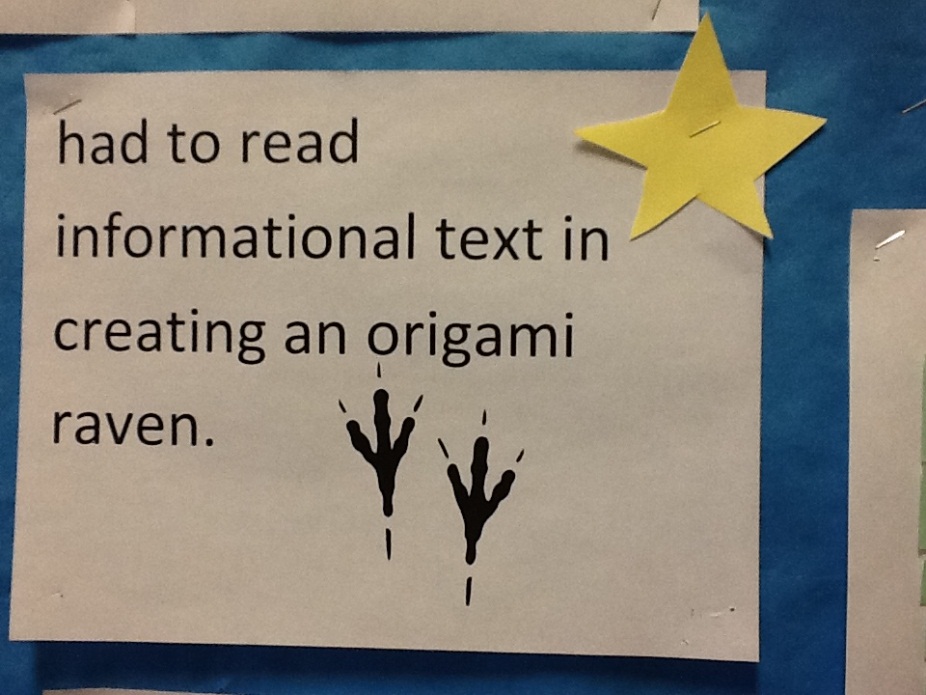
Ms. Kober went on, “All of the skills you see are prior skills. This was just a great way to review. They loved it. I was amazed that they could sequence the story after just hearing it once. And they could read and follow the directions to make origami ravens. That’s reading informational text.”

Take a look at the writing assignments her students completed and what a beautiful bulletin board it made for showing off their work.


Friday, February 15, 2013

Diane Wokltein's Stories Touch Us All

Diane Wolkstein was a teacher, mentor and close friend. I miss her greatly.

One of my favorite stories is ‘I’m Tipingee’ from her collection, The Magic Orange Tree.( You can hear this story on the SAI YouTube Channel ) It is a story of community, among other things, and it has brought community to me through the telling of it.
‘Tipingee’ became a favorite of an elementary school in Glen Rock, New Jersey. For 12 years I told stories in this K-5 school. I taught students and teachers how to tell stories. The school year of stories culminated with a school wide storytelling festival. Everyone, students and teachers, told stories for an afternoon. Before splitting up into small mixed age groups, the school population would gather to start the afternoon with an annual telling of Tipingee. Everyone knew the story; everyone chanted and sang as one. Imagine 350 kids and teachers listening so quietly and then bursting into “I’m Tipingee. She’s Tipingee. We’re Tipingee, too.” We all delighted in the experience together. Diane writes of this extraordinary community in the introduction to the 20th anniversary edition of The Magic Orange Tree.

Professionally Tipingee has broadened my community as well. I tell ‘Tipingee’ in tandem with other tellers. With Elizabeth Nordell (SAI) I tell an English/Creole version. With Julie Pasqual (SAI) I tell an English/Sign Language version. In this way we spread the story to others.

‘I’m Tipingee’ will always have a special place in my heart. I thank Diane for bringing it to our storytelling community that we may pass it on.
--Julie Della Torre

_______________________

Diane Wolkstein grew up one town over from where I live, so when I first started appearing in local storytelling events, audience members often asked if I knew her.  I didn't at first, but when the opportunity availed itself to take a series of workshops with her I signed up.  I trekked in and out of a bitterly cold New York City to her apartment on Patchin Place in Greenwich Village.  There I was warmed by the stories shared and by her welcoming smile.  Her collection of Haitian stories, The Magic Orange Tree, is a legacy Diane Wolkstein gifted not only to the storytelling community, but story lovers everywhere.

--Ellen Musikant
_____________________
 
          There is a photo somewhere in my parents’ house of me, as a little girl, climbing on the statue of Hans Christian Anderson in Central Park.  One of the many advantages of growing up in NYC is that Central Park, and all of its marvels, were available to me anytime I wanted.  I did not attend any of Diane's storytelling there, but years later, when I heard about it, I could imagine my younger self, sitting listening to her, with the background of that beloved statue.  And, the year she asked if I - me, Julie Pasqual - would actually tell a story there, well, my heart about burst in pride.  It was an "I made it moment," just the fact that she knew my name floored me, but that she also thought that I was good enough to stand before that statue and tell to audiences that had cut their storytelling teeth on her, and Laura Simms, and other great and wondrous tellers, well - I was stunned.  It was another couple of years before I felt like Diane and I really talked, and that was about one of her passions - the people of Haiti, I had recently returned from working with a community there, and I could see the love she bore the brilliant, joyful residents of that troubled region.  We sat on a subway one day - I literally almost running into her, and swapped stories of the many smiles, and bright eyes we had seen on our visits.  Though she hadn't been in years, Haiti - as Haiti does - had not left her soul.  Some people just tell stories, some just write them, some just collect them.  But, Diane did this and more - she lived them with a full-hearted passion that set the bar high for all of us that have come after her, because of her.  If I ever get to stand before that statue and tell stories again, I hope her light will feel my soul, and guide my telling.
--Julie Pasqual
____________________
 
When I was first starting out as a storyteller, I found in the library a copy of Diane’s The Red Lion. The tale is from Persia, and recounts a prince’s journey to face his greatest fear, which he must do to succeed his father on the kingdom’s throne. The prince runs away several times before summoning the courage to meet the red lion. And, of course, he is triumphant – but in a surprising way. I always enjoy telling this hero’s journey tale, especially to those on the cusp of adolescence preparing to face their own red lions. It has helped me face red lions of my own. I never had the pleasure of hearing Diane tell this story and I wish I had. The times I did hear her tell I could sense the passion she felt for storytelling and her intense desire to share it. She will be missed.
--Maria LoBiondo
_____________________
 I was in Diane’s physical presence only 5 or 6 times, yet her work has had a deep influence on me as a storyteller.   She was a model of grace and power in her telling and a model of dedication and scholarship.   As have other SAI tellers, I’ve found stories from The Magic Orange Tree especially compelling.  My favorites are “The Name” and  “One, My Darling, Come to Mama.”   The first for its sauciness and the second for much more.
  “One, My Darling” has sparked profound conversations among students.   How is it, many wonder,  that Philamandre, despised and neglected by her mother as a child, does not hesitate to lovingly care for her mother when the woman appears years later.    
  Although I rarely tell this powerful story to young children, I did tell it for a second grade class I had grown to know well.   At the close of the story, a hand shot up.  
  “Why,” demanded the boy, “is she so kind to her mother when her mother was mean to her?”  
     Before I could respond, another hand flew up.  It was Allora.  “I know.”
    “Tell us,” I said.  Allora stood to explain.
    “Philamandre was kind to her mother because she did not want to be like her mother.”   
    Students have also responded deeply to “White Wave,” a Chinese folktale that Diane published with beautiful illustrations by Ed Young.  I tell the story in my own words, but frame it by telling the children how Diane found the story and include, as well, the way she ends the story:
    Many years pass.  Finally nothing remains of the young man, the shrine he built for a goddess and the moon shell in which she once lived.  
   Nothing remains except the story.  That is how it is with all of us; eventually what remains of our lives are our stories. 
--Luray Gross
___________________
 
   My story has something in common with the experience Julie Della Torre recalls. It includes a tale from Diana’s The Magic Orange Tree and there is community singing, too. However, the community in my story is one that feels far away from a Glen Rock elementary school.
 Almost fifteen years ago, I began telling stories in the Morris County Youth Detention Center. When I introduced myself to my first audience of about twenty teenage boys, they scoffed at the idea that I had anything to offer them, but as any storyteller would expect, most of them changed their minds somewhere during the first five minutes of the first story. After that, I taught storytelling workshops at the detention center every week and, although residents came and went, there remained a consensus that Storytelling was, ‘okay.’ That is, it was okay to listen to, discuss and, sometimes, retell stories, but most kids drew the line at active participation as tellers or listeners.
   One day, maybe five months into the program, I invited my friend and colleague, Mary Rachel Platt, to be a guest artist at the facility. The boys who were in residence that day had been there for a long time and most of them were frustrated and worried. They walked into the classroom and slumped into their seats, each one wearing the sullen expression that only teenagers can achieve. Mary began her telling with “Cric, Crac,” the ritual we all learned from Diana to introduce a Haitian story. Her friendly ‘cric’ was greeting with a rolling of eyes, so she just started the tale of Tayzanne, a magical fish.
   There is a song that recurs throughout this story. Its words are simple, but the melody is haunting. By the first time Mary sang it, the boys were engaged in the story. When the song was repeated for a second time, I thought I heard it softly echoed by someone else in the room. I truly didn’t believe my ears, but at the third repetition, the echoing voice was stronger. More voices joined in until, when Mary finished the story by singing the refrain one last time, she was just one voice in a choir made up of every boy in the room.
   Tayzanne is not a happy story, but it was the story those boys needed that day, a tale to take them away from their own worries, if only for the time it took Mary to tell it. There is a lot of Diana in this memory. She truly understood the power of story to describe and mold cultures, preserve rituals, and change lives. From her I learned to forget myself, the teller, and trust the story to catch and hold its listeners.
--Paula Davidoff