Storytelling Arts' mission is to preserve, promote and impart the art of storytelling to develop literacy, strengthen communities and nurture the human spirit.
Showing posts with label children's literature. Show all posts

Saturday, November 30, 2013

Trusting the Tale


Illustration by Arthur Rackham
    Seven Ravens, from the collection of the Brothers Grimm, is one of those stories in which a sister is unwittingly responsible for the suffering of her brothers. In the stories I’ve read, seven or twelve brothers are transformed into birds: swans, geese, or, in this case, ravens. The fate of the brothers is dependent upon the actions of their sister; she is their only hope for a return to normal human existence, but to save her brothers she must make some sacrifice.

In Seven Ravens, the brothers are transformed on the day of the sister’s birth. Because the babe was sickly, the father sent his oldest son to the well to fetch water, so that she could be christened immediately. All of the brothers ran off together and, in the ensuing commotion, the vessel in which they were to carry the water home was knocked into the well.  After waiting a time for his sons’ return, the father supposed that they had been distracted by friends or play and, frantic with concern for the sickly newborn, he spoke the words that must have haunted him for the rest of his life, “I may as well have seven ravens as seven sons.” At that moment, he heard a rustle of wings and, looking up, saw seven ravens fly over the house.
Of course, the sickly babe grew strong, even without the ritual lustration. In time, she discovered the story of her brothers’ disappearance and set out to rescue them. At this moment in the story, it becomes different from the other brothers-to-birds stories I know. First of all, the sister is very young when she begins her journey and she remains a child throughout it. Her journey takes her out of this world, to the homes of the sun, the moon, and the stars. In this last place, she learns that her raven brothers live in a glass mountain, and she is given a bone that will unlock its door. After another long journey, she reaches the mountain only to find that she has lost the bone-key. She despairs until, realizing that her own little finger is the same size and shape of the bone, she cuts off her finger, puts it into the keyhole, and unlocks the door. After this, the events of the story flow smoothly to the brothers’ change back into human beings, and all of the children return home to their parents.

I tell this story a lot. I sympathize with the poor father and pray that I will never be held to such close account for thoughtless speech. I am moved by the courage of the heroine, and I love the fact that, unlike many folktale sisters, she is granted her accomplishment while she is still a child. I love the images that come to my mind as I tell: the boys, looking at each other as the splash from the fallen pitcher echoes in the well, and therefore, each witnessing the transformation of the others; the seven great black birds flying over the thatched roof of the house; the sister walking through the world carrying her little chair on her back; the stars in shining raiment, each sitting in its own seat, and the little girl placing her chair among them. I remember the faces of my own children as I watch her earnest explanation of her predicament. Later, I see the thick, black velvet curtain behind which she hides to wait for the ravens’ appearance. I see the dull gleam of the mother’s golden wedding band at the bottom of the seventh raven’s wine glass, and I see the brothers and their sister start, hand-in-hand, on their journey home.
However, there is one moment in the story that I do not see clearly, that is the child’s self mutilation. My cerebral imagination by-passes the event. It is only accessible through the heart. I hope that the children to whom I tell the story also experience that moment as I do, but of course, I don’t know. I watch their faces as it happens, and I have never yet seen a sign of the horror that a vivid image of the picture must evoke. When the story is over, they often ask about it. The occasional fifth grade boy says, “gross” or “cool” when he refers to it. But children seem to understand that difficult tasks require a sacrifice and that the best things are worth it.  

Yesterday I was telling Seven Ravens to a mixed audience of about thirty people who were attending a holiday arts celebration in Madison, NJ. The storytelling site was a small, lovely alcove in the Museum of Early Trades and Crafts. Children sat at my feet on a richly colored Persian rug; their parents and other adults sat in chairs behind them. As the little girl in the story approached the glass mountain, I looked into the faces of the children on the front row. They were completely absorbed in the tale – their eyes were fastened on me, their mouths slightly open. I looked beyond them at the adults and saw that a young adult couple sitting on a bench at the side of the room were just as present in the story.
The youngest children in the room were between two and four years old, much younger than my usual audience, and as I moved toward the story’s climax, I began to doubt myself. I wasn’t sure that I should tell it properly. I was afraid of what the children might see. I thought that maybe I would just say that the sister put her finger in the keyhole without cutting it off. It wouldn’t be so different, I told myself. She would be using her intact body to release her brothers, instead of sacrificing her finger to her quest.
As I write this, it seems odd to me that I could have had this series of thoughts without breaking the narration of the tale, but in the five or six sentences between the time the sister realized she had lost the bone-key and the cutting of her finger, I went back in forth in my mind about what to do. Just as the sister realized that her finger might be a substitute for the key, I glanced up at the couple on the bench. They met my gaze and I saw that the young woman’s eyes were brimming with tears. In that second, I knew that I couldn’t betray the story. There was, at least, one listener who needed the tale intact. I didn’t dwell in the moment. As soon as the girl found the solution to her problem, I spoke in one breath, “She took the knife she had brought to cut her bread, cut off her little finger, and when she held it between her thumb and forefinger and stood on her little chair, it just reached the keyhole and the door of the glass mountain swung open.”
As I spoke, I enacted her movements, but when the girl entered the glass mountain, I stopped talking, stood still, and took as few seconds to see the interior of the mountain and to look into the little faces on the front row. The children’s eyes were open wide, but they were smiling. They knew that everything would be fine. I looked at the young woman on the side. There were tears on her cheeks, but she was smiling, too. 
Postcard illustration by Oskar Herrfurth

“Trust the story,” I say to parents who wonder if they should read the “real” fairy tales to their children. Sometimes, we tellers need to be reminded, too. 


Thursday, March 14, 2013


Fifth Graders Working With Ravens
 - Julie Della Torre, Storyteller

The strongest work we as storytellers do in the classroom, the work that has the most impact on students is when the teacher and the storyteller work collaboratively--two professionals working together, a professional storyteller and a professional teacher--each bringing unique skills to the project.

The professional storyteller does the work of learning her/his story in-depth.  The storyteller researches and finds the story, learns the text, analyzes the story, and studies the culture from which the story emerges. She/he understands different types of stories from the folklore genre.

The professional teacher knows her/his students.  She/he is eminently familiar with grade curriculum and the skills students need in their classroom.

By telling stories and leading literary discussions of the stories, the storytelling gives a class an oral text from which to work on all types of curriculum. We storytellers hope that teachers learn from our tellings and from the follow-up discussions and activities. In truth, we storytellers, if we take time to listen to teachers, learn much more.

I was the storyteller for a Storytelling Arts residency in a middle school in Paterson, New Jersey.  As part of the residency I told stories to the 5th and 7th grades and facilitated follow- up discussions.

The goals for the project were to

·         Increase students' awareness, comprehension, and appreciation of literature.

·         Improve listening skills.

·         Stimulate students' imaginations.

·         Help students' to have a more intuitive understanding of story structure which will carry over into their writing skills.

·         Reinforce teachers' understanding that the ancient art of storytelling can serve and integral role in the school curriculum

·         Increase students' awareness, comprehension, and appreciation that stories are the world’s culture

 But as you will see below, the fifth grade teacher, Ms. Kober, went far beyond these goals. It was the second year for me in her classroom.  I told the story ‘The Seven Ravens’ from the Brothers Grimm. Ms. Kober spoke of her experience with storytelling. She said, “Last year I didn’t know what to expect, but now I know what I can do with it (storytelling). It’s great when you come in because I’m not a good storyteller. I can’t do it. So it’s great to have you and then I can take it from there.”

And she did! After hearing the story, she had the students do all sorts of reading and writing.

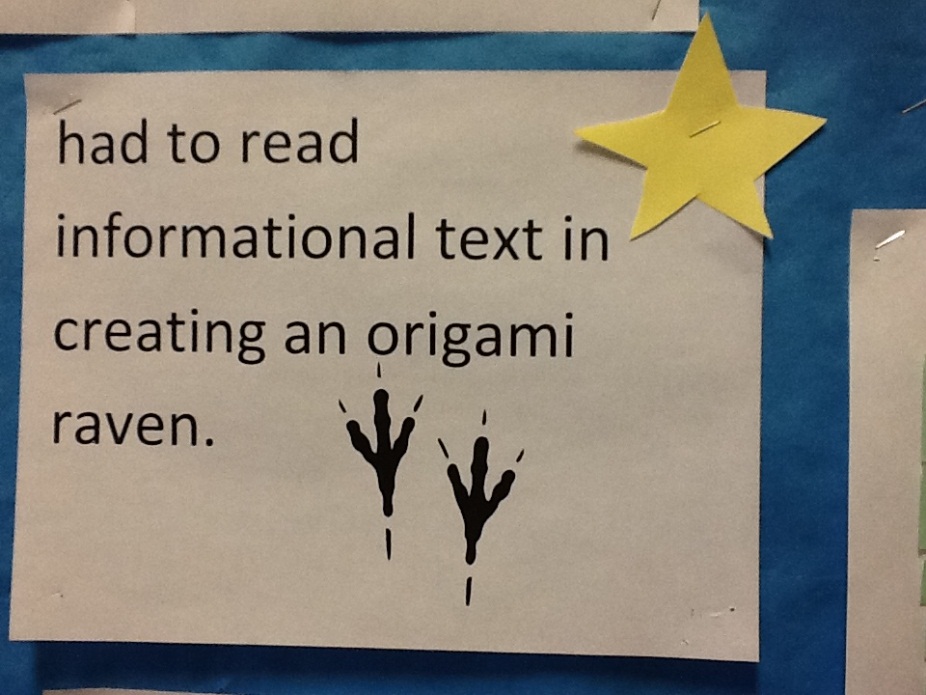
Ms. Kober went on, “All of the skills you see are prior skills. This was just a great way to review. They loved it. I was amazed that they could sequence the story after just hearing it once. And they could read and follow the directions to make origami ravens. That’s reading informational text.”

Take a look at the writing assignments her students completed and what a beautiful bulletin board it made for showing off their work.


Wednesday, December 19, 2012

Making New Things Familiar


Unless I’m actively promoting myself as a storyteller, I almost never tell people what I do for a living. When I fill out forms that require me to state my occupation, I write “teacher,” and when asked about my job, I say that I teach literacy education. It’s so much easier than saying I’m a storyteller. I learned years ago that when I tell people what I really do, I have to explain myself. And the explanation is never satisfying because a person who has not experienced storytelling can’t understand what it is.
The conversation goes something like:
“You read aloud?”
“No, I don’t read stories, I tell them.”
“Uh huh.”
“I mean, I don’t hold a book, I just look at an audience and tell the story.”
“You memorize it?”
“Not exactly, I sort of perform it.”
“Oh, you’re an actress!”

So, after a while, I just stopped saying that I’m a storyteller. It’s too frustrating.

But a few months ago, I was sitting in my kitchen writing a check for a plumber who had just unclogged my bathroom sink. He was telling me about a wedding he had just attended. Mostly he was marveling about what it must have cost. When he told me the name of the venue, I said,
“Oh, I know that place. I did a job there once.”
Because it would have made no sense to say I taught literacy at a wedding venue, when the man inquired about my job, I had to come clean.
“I’m a storyteller,” I said, resigning myself to the inevitable nonexplanation.
The plumber’s eyes grew wide. He put down the pen he was using to write my receipt and said, “You mean you’re one of those people who can stand in front of an audience, and just by talking, make everyone feel like they’re in another world?”
I was floored! What could I do but say “yes” as modestly as possible?
“I saw a storyteller once,” he continued. “It was, maybe, fifteen years ago, when I was in high school. We had an assembly and this lady came out on the stage. At first it was kind of embarrassing, because the whole school was in the auditorium and none of us knew why she was there. Honestly, she didn’t look like much, but when she started talking, it was like she cast a spell over the room. Everyone was sitting at the edge of their seat with their mouths hanging open. I’ll never forget it.”

As we talked more about the experience, he told me that the storyteller had left a stronger impression on him than “shows or musicals or movies.” I wasn’t surprised to hear this, because I’ve had the same experience listening to my teachers and colleagues tell stories. The conversation did, however, make me wonder, once again, why the quiet art of storytelling packs such a big punch. I decided to begin asking my audiences about it. One of the places I asked was in the fifth grade classroom of my friend, Joan Kenny.
I have been telling stories and facilitating writing activities in Joan’s classroom for several years. At this point, I look for opportunities to teach there because I know I will always find myself working with a group of extraordinary students: children who are passionate, curious, thoughtful, creative, and willing to take risks to learn something new. Joan’s kids represent a cross section of public school students from a racially, culturally, and economically diverse community, but year after year, they defy the current stereotype of  the unmotivated and uninformed American public school student. You don’t have to be in that classroom for long to understand why. Joan is a wonderful teacher, one of the best I’ve ever seen. She makes everything exciting, and her classroom is a place where students know their thoughts and ideas will be met with interest and respect. When I told her what I wanted to ask her students about storytelling, she said,
“Tell them you need their advice. That always pulls them in.”
So when I met with the students, I asked them if they thought listening to a storyteller might help kids learn. Their answers were, of course, all positive, (They are very polite to classroom visitors!) but it was their actions that impressed me. Some of the things they said were,
“Listening to a storyteller helps you learn because it makes you imagine.”
“And get ideas.”
“Stories evoke emotions.”
“When you tell us a story, it makes new things seem familiar.”
“A story stays with you.”

When I asked the student who made the last remark to give me an example, he stood up and gazed at a spot on the ground in front of him with a worried expression. Then he spoke. 
“When the man saw the injured bird, he picked him up very gently.” As he spoke, he stepped forward and bent over, cupping his hands as if he were scooping an object off the floor. 
I realized that he was mimicking the actions and facial expressions I had probably used several weeks earlier when I told his class a story called “Just Rewards.” Before I could say anything, another boy jumped up and walked toward one of the desks. His hands were also cupped as if he were holding the bird, and when he reached the desk, he pretended to place the bird on it and make it comfortable.
“That’s the basket,” said a girl who was watching.
“He’s putting in a soft blanket,” added another student.
As I watched and listened, I was pretty sure that I was seeing a much more detailed version of the story than the one I had told. The movements were more elaborate and continuous, as were the visual details that students continued to describe.
When the second boy sat down, all of the kids had their hands in the air. One after another, they told bits of stories, using their faces and bodies as well as their voices. Each time, I saw and heard something new. The children were not simply imitating me; they had synthesized the information I gave them when I told the stories, and they were giving back their own interpretations. Moreover, they had processed the stories after hearing them only once, and could still recount them weeks or, in some cases, months later.

None of this anwers the “why” of my original question. Why does my plumber have such a powerful memory of the storyteller he heard when he was a teenager? Why are Joan’s fifth graders able to remember and retell a story with so little effort?  I know that there are philosophical and physiological explanations for why people react to storytelling the way they do, and I think some of them are probably right. I also think that part of the answer to my question lies in something one of the fifth graders said: Story makes new things seem familiar.
When a storyteller gives a tale to an audience, she presents it in ways that touch each person’s mind and heart and spirit. The story becomes more than words. It is a gesture that a grandmother used to make, an expression on a father’s face, the sound of an old friend’s voice. Each listener recognizes something in the teller’s words and movements that helps him place the story within his own experience. The story becomes more than text or spectacle. It becomes a personal memory, part of the listener’s own life journey.
Receiving a story is a complex and unique experience. Which is why people who have never heard a storyteller just can’t understand what she does!

Paula Davidoff, Storyteller

Wednesday, October 24, 2012

Truth in "Lies"

Last week I told stories for nine groups of first graders: one in which a tortoise rides on eagle’s back, one in which a strange visitor arrives one body part at a time, one in which a wolf demands that a little girl sing to him, another in which a man’s doctor is none other than a python.  Midway through the second day, I realized I had not yet heard that oft-asked question, “Is that true?”


These six and seven-year olds seemed entirely comfortable in the imaginative world of folk and fairy tale, where every story is really a story about the human condition, providing metaphors which do not have to be analyzed in order to be useful.  They seemed to intuit that these traditional tales contain truth even if the events never happened.


As teachers and parents we want our children to value honesty and to be able to live in the everyday world where we cannot count on physical magic, understand the language of the animals, or witness a giant pumpkin’s sky-born seeds turning into stars.


Perhaps it was partly this desire to prepare children for “the real world” that was behind one teacher’s consternation when a boy in her class told me that his father had gone to a skeleton doctor (not an orthopedist, but a doctor that was a skeleton) and got better.  “I forgot to tell you,” she quietly told me as I left the room,  “He is always lying.  He’s been referred to counseling.”  Her concern for her student was palpable.


In the days since that session, I have found myself trying to “unpack” this brief episode.  Many of us often feel the need to soften or stretch the truth, and we sometimes to go even further in both our discourses with others and our internal conversations.  The stories told by this little boy, new to both the school and the community, may come from his need to be acknowledged and to fit in. 


For me, his claims certainly confirmed that he had absorbed the story I’d just told, a folk tale from Zimbabwe called “Nyangara, the Python.”  In the tale, a group of brave children accomplish a task from which the men of the village flee.  They carry a chief’s doctor, a huge snake, down from his mountain cave and the very ill chief, gently tended by Nyangara, immediately regains his strength.


Coming to this story as an adult, I have always focused on the irrepressible innocent courage of the children, rather than on the magical powers of the snake.  But I am guessing that the boy who spoke of the skeleton doctor was hearing something very important about a child/father relationship.  In the tale, the chief refers to all of the kids as “my children” and prepares a great feast for them because they were able to do what the men were too frightened to do.  It is clear that the children save the man’s life.


Though I know nothing of this student’s family, I do know how it feels to be able to make an ailing parent feel better.   I vividly remember the months before my own father had the back surgery he so needed.  I was seven, the oldest of five, living on a busy dairy farm.  In school, I was a rather timid second grader.  At home, I was the capable one who could feed and dress my baby twin sisters while my mother was out in the barn or keep my two other sisters occupied by reading to them.  Nothing, however, made me feel as useful and as important as giving my dad a back rub.  “Press hard,” he’d say as I leaned into the tight muscles along his spine.  “That’s right.  That helps.”  


Now my father is 87. His heart is failing, his memory in shambles.  Sometimes, instead of dutifully working on his checkbook or cleaning his kitchen, I tell him a story I’m working on.  He is an attentive listener, still a thoughtful man, one who appreciates the truths wrapped up in the “lies” of the story.  I am grateful.

 
LURAY GROSS works extensively in schools and the community presenting workshops and performances for all ages. She is a believer in the power of stories and poems as resources nurturing heart, mind, and spirit. Under the auspices of Storytelling Arts, Inc., she brings multicultural folktales into the classroom and facilitates response and elaboration, particularly through writing. Her own love of the spoken and written word, of the outdoors, and of music were all nurtured by her experiences growing up on a busy dairy farm in Pennsylvania.

Luray is the author of three collections of poetry: Forenoon was published in 1990 by The Attic Press in Westfield, NJ, and Elegant Reprieve won the 1995-96 Still Waters Press Poetry Chapbook Competition. The Perfection of Zeros, was published by Word Press in 2004.

Thursday, September 6, 2012

Watching Snow White by Storyteller Julie Della Torre


There was no escaping Snow White in early 2012. At least two feature films were made of her, and made with big box office stars. So I took my adult daughter to Snow White and the Huntsman, and then borrowed a number of Snow White films from the library and sat down to watch.
Since  reading an article “Creating Variants With Illustrations” by Patricia Cianciolo (Blatt: Once Upon a Folktale), I’ve been studying picture book versions of stories I tell and noticing how the stories are informed by choices the illustrators make.  Different scene choices, styles, and character illustrations make their own variants of the story. As a storyteller, I have also been working with the Snow White story and its many print variants. I decided to explore this same concept of variants through film by watching films with an eye to specific choices made by script writers and directors. Here are some discoveries I made. Please note that my discussion of the movies will not be focused on the actors’ performances, the quality of the film or the director. I will not recommend, nor will I dismiss the films. These notes are not film reviews.

What I watched (Though I watched many more films, these are the ones I would like to discuss)

·         Snow White and the Huntsman (2012) with Charlize Theron as the Queen and Kristen Stewart as Snow White

·         Mirror, Mirror (2012) with Julia Roberts as the Queen and  Lily Collins as Snow White

·         Willa: An American Snow White (a Tom Davenport film  1998) with Caitlin O’Connell  as the Stepmother and Becky Stark as  Willa (Snow White)

·         Snow White episode in Fairie Tale Theater (Shelly Duvall 1984  ) with Vanessa Redgrave as the Queen and Elizabeth McGovern as Snow White

·         Snow White, Fairest of Them All (made for TV 2001) with Miranda Richardson as the Queen and Kristen Kruek as Snow White

What makes Snow White Snow White? What needs to be included so that we know the tale is a Snow White tale?
·         an evil, beautiful stepmother
·          enchanted woods
·          a particular season
·          dwarves
·          a mirror
·          a huntsman
·          a prince
·          magic killing objects
·         coffin, sleep
·          and of course, Snow White

I’ll concentrate on only a few of these.

WOODS AND SEASON
Snow White is a tale of winter and return of spring. Willa is set in the southern part of the United States. No winter here, but all the other films have scenes of cold winter, ice and frozen lands. Sometimes winter is just mentioned at the beginning… three drops of blood on the snow. Sometimes just including an animal associated with winter is enough. Interesting in Fairest of Them All that the film starts with apple blossoms falling like snow. Father wishes for a daughter with skin as white as snow, etc. There is snow throughout this movie. The enchanted forest in Mirror, Mirror is blanketed with snow.

Going over and into the enchanted woods is a part of all of the movies. The woods Barker goes through in Willa are realistic, but scary woods. The time she spends with the ‘dwarves’ is on the road in a traveling medicine show. Duvall’s woods are supposed to be just realistic woods. The others are truly magical. We know we are in an enchanted place. In Huntsman and Fairest we are transported to these woods with sweeping aerial views.

EVIL STEPMOTHER
Be she Queen or not, all the stories have a beautiful, evil stepmother. It’s a wonder that the title is Snow White since the strongest character is really that evil Queen. What’s motivating this stepmother? Choices made by scriptwriter and director give different impressions. In Huntsman and Fairest of them All, the Queen is surely beautiful, but more than vain, she is power hungry. Theron wants to rule the kingdom and live forever. She doesn’t just need to see Snow White dead; she needs to eat the girl’s heart. Richardson does eat the girl’s heart… or so she is led to believe. The message here is beauty equals power. Julia Roberts also wants to rule the kingdom, but more than craving power, this Queen is vain and terrified of aging. She can’t bear to see the daughter, young and beautiful. Redgrave is only concerned with beauty and age. O’Connell (an aging actress, not a Queen) is obsessed with aging and a fading theatrical career soon to be usurped by her beautiful stepdaughter.

Watching these women lose control and come unraveled was quite intriguing. Redgrave does it just with her hair. The more her hair is out of control, the more crazed she becomes twirling madly to her death at the end.  Only in Willa does the Evil Stepmother meet her demise by fire.
Some of the films bring in mythological allusions. In Mirror, Mirror and Fairest of Them All, there are explicit references to the moon goddesses through use of jewelry and moons. And peacock feathers can be found in Disney’s queen and on Julia Roberts. Is that mythological?

THE MIRROR
The mirrors were the most fun to study-- some fantastic mirrors and what a different message the physical properties of the mirror send. First of all, who or what does the stepmother see when she looks into it? Who or what responds? Do the mirrors have any other magical powers? In Huntsman and Duval’s Snow White the face/voice of the mirror is a man. In Duval’s the mirror is Vincent Price and is the narrator of the story, holding conversations with the Queen: a mirror with attitude. In Willa, the mirror is a vanity table mirror that reflects the stepmother’s last performance of Romeo and Juliet with all of the ovations she received clearly audible. Apparently, all mirrors are dangerous to her for all are covered throughout the house or locked up in drawers. In Mirror, Mirror, Julia Roberts walks into the mirror (like Alice?) and sees her beautiful self-reflected. She also holds conversations with the mirror (herself): another mirror with attitude.

I thought the Huntsman mirror was the most arresting. (you can see it here YouTube) Then I saw the mirror in Fairest of them All. The concept for this mirror outdid the rest. It’s a bit complicated. The Queen is ugly at the beginning of the movie. She is given an evil mirror which she breaks because she is afraid to see her reflection. A piece of it flies into the eye of the King. (Anderson’s Snow Queen?) He sees her as beautiful and he is now in her power.  But one bigger piece remains and it is placed on a special stand in a special room. This room is a dressing room and the mirror is a dressing room mirror, the kind where you see your full self-reflected on and on and on. I had done some study on labyrinths and one labyrinth is just such a mirror. You can lose yourself in a mirror like this. Very fitting. Richardson sees her whole self-reflected until Snow White becomes more beautiful and from then on Snow White reaches out from every mirror and answers “Who is the fairest of them all?” with “I am, I am, I am…” The remaining piece of mirror has other powers as well. It can show the Queen exactly where Snow White is. (I remember this quality in some other films as well) It can transport the Queen when she steps into it. It can transform the Queen once, to look like Snow White’s mother.  It is the weapon used to kill the huntsman. Quite a powerful mirror indeed.

Some other things I noticed and found intriguing
The sashes in Duvall’s piece and in Fairest of Them All were worth noting. Vanessa Redgrave’s beribboned crone twirls around making those beautiful ribbons impossible to resist. And the magical sash in Fairest quickly turns from a pretty, tied bow to a suffocating knot.

Puppets played prominently in Mirror, Mirror and in Willa.  Both movies start with puppets. The beginning of the tale is told through puppets in Mirror, Mirror. Later Julia Roberts is able to destroy the dwarves’ house by manipulating puppets. Willa opens with Willa (Snow White) playing out a fairy tale with her little puppet theatre. Learning of her stepdaughter’s interest in theatre, the stepmother is enraged when she finds this puppet theatre.  The whole of Willa is about acting and theatre.

I was fascinated to find a Betty Boop cartoon (1933) of Snow White on YouTube. It is of its time, but it does include many of the attributes of Snow White discussed above. Watch and notice the Evil Queen, the mirror, snow, the huntsman (prince?) the ice casket and the demise of the queen.  (Betty Boop 1933 Cab Calloway "Snow-White" on YouTube - Betty Boop)
Julie has been telling traditional and literary fairytales to audiences of all ages since 1985. Her nine years of elementary school teaching and her study of child development and curriculum have made Julie finely attuned to stories that are age appropriate. Julie says, “My background in education helps me to choose stories that are appropriate to students’ developmental levels. The myths and folktales which I tell are filled with ethical dilemmas which provide a catalyst for deep discussion and reflection. For this reason I prefer classroom telling.”