Storytelling Arts' mission is to preserve, promote and impart the art of storytelling to develop literacy, strengthen communities and nurture the human spirit.
Showing posts with label listening. Show all posts

Thursday, March 14, 2013


Fifth Graders Working With Ravens
 - Julie Della Torre, Storyteller

The strongest work we as storytellers do in the classroom, the work that has the most impact on students is when the teacher and the storyteller work collaboratively--two professionals working together, a professional storyteller and a professional teacher--each bringing unique skills to the project.

The professional storyteller does the work of learning her/his story in-depth.  The storyteller researches and finds the story, learns the text, analyzes the story, and studies the culture from which the story emerges. She/he understands different types of stories from the folklore genre.

The professional teacher knows her/his students.  She/he is eminently familiar with grade curriculum and the skills students need in their classroom.

By telling stories and leading literary discussions of the stories, the storytelling gives a class an oral text from which to work on all types of curriculum. We storytellers hope that teachers learn from our tellings and from the follow-up discussions and activities. In truth, we storytellers, if we take time to listen to teachers, learn much more.

I was the storyteller for a Storytelling Arts residency in a middle school in Paterson, New Jersey.  As part of the residency I told stories to the 5th and 7th grades and facilitated follow- up discussions.

The goals for the project were to

·         Increase students' awareness, comprehension, and appreciation of literature.

·         Improve listening skills.

·         Stimulate students' imaginations.

·         Help students' to have a more intuitive understanding of story structure which will carry over into their writing skills.

·         Reinforce teachers' understanding that the ancient art of storytelling can serve and integral role in the school curriculum

·         Increase students' awareness, comprehension, and appreciation that stories are the world’s culture

 But as you will see below, the fifth grade teacher, Ms. Kober, went far beyond these goals. It was the second year for me in her classroom.  I told the story ‘The Seven Ravens’ from the Brothers Grimm. Ms. Kober spoke of her experience with storytelling. She said, “Last year I didn’t know what to expect, but now I know what I can do with it (storytelling). It’s great when you come in because I’m not a good storyteller. I can’t do it. So it’s great to have you and then I can take it from there.”

And she did! After hearing the story, she had the students do all sorts of reading and writing.

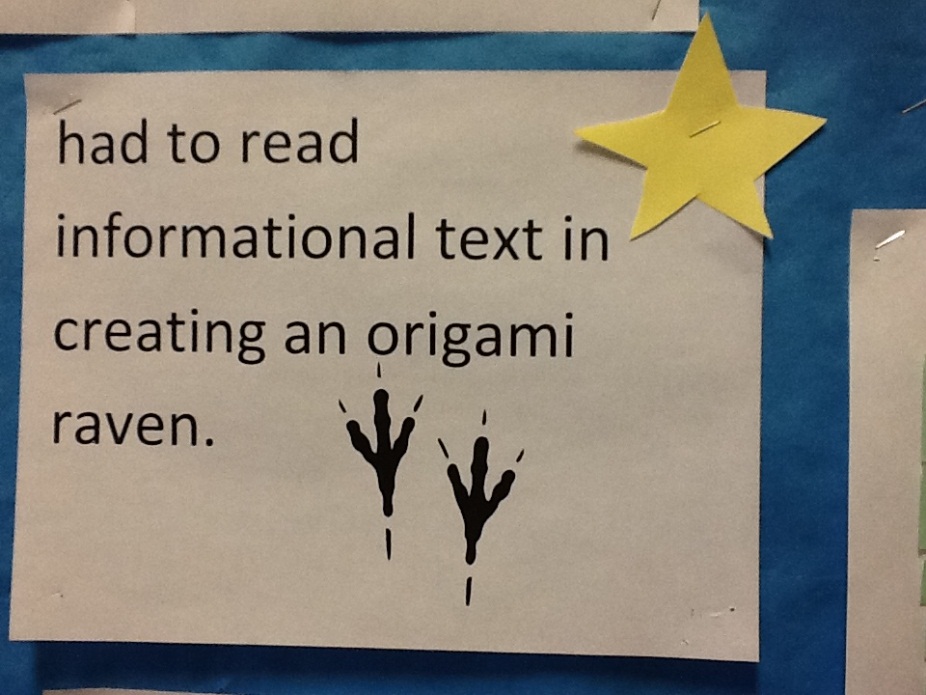
Ms. Kober went on, “All of the skills you see are prior skills. This was just a great way to review. They loved it. I was amazed that they could sequence the story after just hearing it once. And they could read and follow the directions to make origami ravens. That’s reading informational text.”

Take a look at the writing assignments her students completed and what a beautiful bulletin board it made for showing off their work.


Friday, February 15, 2013

Diane Wokltein's Stories Touch Us All

Diane Wolkstein was a teacher, mentor and close friend. I miss her greatly.

One of my favorite stories is ‘I’m Tipingee’ from her collection, The Magic Orange Tree.( You can hear this story on the SAI YouTube Channel ) It is a story of community, among other things, and it has brought community to me through the telling of it.
‘Tipingee’ became a favorite of an elementary school in Glen Rock, New Jersey. For 12 years I told stories in this K-5 school. I taught students and teachers how to tell stories. The school year of stories culminated with a school wide storytelling festival. Everyone, students and teachers, told stories for an afternoon. Before splitting up into small mixed age groups, the school population would gather to start the afternoon with an annual telling of Tipingee. Everyone knew the story; everyone chanted and sang as one. Imagine 350 kids and teachers listening so quietly and then bursting into “I’m Tipingee. She’s Tipingee. We’re Tipingee, too.” We all delighted in the experience together. Diane writes of this extraordinary community in the introduction to the 20th anniversary edition of The Magic Orange Tree.

Professionally Tipingee has broadened my community as well. I tell ‘Tipingee’ in tandem with other tellers. With Elizabeth Nordell (SAI) I tell an English/Creole version. With Julie Pasqual (SAI) I tell an English/Sign Language version. In this way we spread the story to others.

‘I’m Tipingee’ will always have a special place in my heart. I thank Diane for bringing it to our storytelling community that we may pass it on.
--Julie Della Torre

_______________________

Diane Wolkstein grew up one town over from where I live, so when I first started appearing in local storytelling events, audience members often asked if I knew her.  I didn't at first, but when the opportunity availed itself to take a series of workshops with her I signed up.  I trekked in and out of a bitterly cold New York City to her apartment on Patchin Place in Greenwich Village.  There I was warmed by the stories shared and by her welcoming smile.  Her collection of Haitian stories, The Magic Orange Tree, is a legacy Diane Wolkstein gifted not only to the storytelling community, but story lovers everywhere.

--Ellen Musikant
_____________________
 
          There is a photo somewhere in my parents’ house of me, as a little girl, climbing on the statue of Hans Christian Anderson in Central Park.  One of the many advantages of growing up in NYC is that Central Park, and all of its marvels, were available to me anytime I wanted.  I did not attend any of Diane's storytelling there, but years later, when I heard about it, I could imagine my younger self, sitting listening to her, with the background of that beloved statue.  And, the year she asked if I - me, Julie Pasqual - would actually tell a story there, well, my heart about burst in pride.  It was an "I made it moment," just the fact that she knew my name floored me, but that she also thought that I was good enough to stand before that statue and tell to audiences that had cut their storytelling teeth on her, and Laura Simms, and other great and wondrous tellers, well - I was stunned.  It was another couple of years before I felt like Diane and I really talked, and that was about one of her passions - the people of Haiti, I had recently returned from working with a community there, and I could see the love she bore the brilliant, joyful residents of that troubled region.  We sat on a subway one day - I literally almost running into her, and swapped stories of the many smiles, and bright eyes we had seen on our visits.  Though she hadn't been in years, Haiti - as Haiti does - had not left her soul.  Some people just tell stories, some just write them, some just collect them.  But, Diane did this and more - she lived them with a full-hearted passion that set the bar high for all of us that have come after her, because of her.  If I ever get to stand before that statue and tell stories again, I hope her light will feel my soul, and guide my telling.
--Julie Pasqual
____________________
 
When I was first starting out as a storyteller, I found in the library a copy of Diane’s The Red Lion. The tale is from Persia, and recounts a prince’s journey to face his greatest fear, which he must do to succeed his father on the kingdom’s throne. The prince runs away several times before summoning the courage to meet the red lion. And, of course, he is triumphant – but in a surprising way. I always enjoy telling this hero’s journey tale, especially to those on the cusp of adolescence preparing to face their own red lions. It has helped me face red lions of my own. I never had the pleasure of hearing Diane tell this story and I wish I had. The times I did hear her tell I could sense the passion she felt for storytelling and her intense desire to share it. She will be missed.
--Maria LoBiondo
_____________________
 I was in Diane’s physical presence only 5 or 6 times, yet her work has had a deep influence on me as a storyteller.   She was a model of grace and power in her telling and a model of dedication and scholarship.   As have other SAI tellers, I’ve found stories from The Magic Orange Tree especially compelling.  My favorites are “The Name” and  “One, My Darling, Come to Mama.”   The first for its sauciness and the second for much more.
  “One, My Darling” has sparked profound conversations among students.   How is it, many wonder,  that Philamandre, despised and neglected by her mother as a child, does not hesitate to lovingly care for her mother when the woman appears years later.    
  Although I rarely tell this powerful story to young children, I did tell it for a second grade class I had grown to know well.   At the close of the story, a hand shot up.  
  “Why,” demanded the boy, “is she so kind to her mother when her mother was mean to her?”  
     Before I could respond, another hand flew up.  It was Allora.  “I know.”
    “Tell us,” I said.  Allora stood to explain.
    “Philamandre was kind to her mother because she did not want to be like her mother.”   
    Students have also responded deeply to “White Wave,” a Chinese folktale that Diane published with beautiful illustrations by Ed Young.  I tell the story in my own words, but frame it by telling the children how Diane found the story and include, as well, the way she ends the story:
    Many years pass.  Finally nothing remains of the young man, the shrine he built for a goddess and the moon shell in which she once lived.  
   Nothing remains except the story.  That is how it is with all of us; eventually what remains of our lives are our stories. 
--Luray Gross
___________________
 
   My story has something in common with the experience Julie Della Torre recalls. It includes a tale from Diana’s The Magic Orange Tree and there is community singing, too. However, the community in my story is one that feels far away from a Glen Rock elementary school.
 Almost fifteen years ago, I began telling stories in the Morris County Youth Detention Center. When I introduced myself to my first audience of about twenty teenage boys, they scoffed at the idea that I had anything to offer them, but as any storyteller would expect, most of them changed their minds somewhere during the first five minutes of the first story. After that, I taught storytelling workshops at the detention center every week and, although residents came and went, there remained a consensus that Storytelling was, ‘okay.’ That is, it was okay to listen to, discuss and, sometimes, retell stories, but most kids drew the line at active participation as tellers or listeners.
   One day, maybe five months into the program, I invited my friend and colleague, Mary Rachel Platt, to be a guest artist at the facility. The boys who were in residence that day had been there for a long time and most of them were frustrated and worried. They walked into the classroom and slumped into their seats, each one wearing the sullen expression that only teenagers can achieve. Mary began her telling with “Cric, Crac,” the ritual we all learned from Diana to introduce a Haitian story. Her friendly ‘cric’ was greeting with a rolling of eyes, so she just started the tale of Tayzanne, a magical fish.
   There is a song that recurs throughout this story. Its words are simple, but the melody is haunting. By the first time Mary sang it, the boys were engaged in the story. When the song was repeated for a second time, I thought I heard it softly echoed by someone else in the room. I truly didn’t believe my ears, but at the third repetition, the echoing voice was stronger. More voices joined in until, when Mary finished the story by singing the refrain one last time, she was just one voice in a choir made up of every boy in the room.
   Tayzanne is not a happy story, but it was the story those boys needed that day, a tale to take them away from their own worries, if only for the time it took Mary to tell it. There is a lot of Diana in this memory. She truly understood the power of story to describe and mold cultures, preserve rituals, and change lives. From her I learned to forget myself, the teller, and trust the story to catch and hold its listeners.
--Paula Davidoff

Wednesday, February 6, 2013

Listening: the other side of telling


As a teaching artist, I do much of my work in other teachers’ classrooms. Over the years, I have both spent a fair amount of time talking with administrators, planning with teachers, and observing student / teacher interactions. One thing I have observed is that in most school situations, students are given few opportunities to speak at any length. There are many reasons for this, some more legitimate than others, but I think that however valid the reason for keeping students quiet, the result is that, by the time they get to middle school, many children are uncomfortable expressing their opinions in front of teachers and classmates. There is always the suspicion that when an adult poses a question, he or she does so with an answer already in mind, and students quickly learn that wrong answers might be greeted by classmates with distain or ridicule. The irony of this situation is, of course, that one of the best ways to assess what a student knows is by listening to him talk. Student discussions throw light on the speakers’ misconceptions and missing knowledge in a way that most pen-and-paper tasks cannot, and aural assessment can be done in a fraction of the time it takes to read and evaluate a stack of essays.
Because we don’t have to worry about things like test scores and administrative edicts, my colleagues and I have the luxury of allowing students to spend hours of workshop time in talk. Although the work of our programs develops literacy skills and broadens our students’ knowledge base, these outcomes are a means to our main program goal, and not the goal, itself. Creating opportunities for unfettered student discussion is a crucial part of our process toward the goal of encouraging independent thought and increasing self-confidence. It is through discussion with each other that students develop their own ideas and gain assurance that they can voice them convincingly.
That said, productive student talk has to be directed, and I think directing classroom conversation is one of the most important skills we teaching storytellers can develop. I would bet we all agree that the most crucial element of that skill is our ability to listen. There are times when student discussions call for adult intervention, but they occur less frequently than most adults (myself included!) imagine. A guidance counselor who co-teaches in one my programs once told me that before interjecting a remark, a facilitator should always say to herself, W.A.I.T. –  Why Am I Talking? I have learned that the reason for my own impulse to speak up is usually that I’m afraid the kids won’t be able to resolve an issue unless I lead the discussion. Silence and patience have taught me that, given enough time and direction, they usually reach on their own the point I wanted to make. As they talk without adult interference, students gain confidence in their ability to speak for themselves. The model of an adult respectfully listening, voicing agreement or disagreement with only a word or a nod, teaches them one of the most important rules of successful social interaction, namely that it requires a balance of action and observation; of speaking and listening.

A couple of weeks ago, I sat at the back of a workshop that was being led by four student storytellers who participate in a storytelling program at Frelinghuysen Middle School in the Morris School District. In that program, which I direct, students learn to tell stories through a variety of artistic media. It is a long-term program and students who join in their 6th grade year often remain in the program  until they leave the school after 8th grade. Every year, when I introduce a new group of 6th graders to the storytelling program, I ask some older student storytellers to take part in the presentation. The students who were leading the workshop in question had been in the program for a year.
Near the end of the session, one the workshop leaders, Anjel, said to the new recruits, “Storytelling is a very relaxed place.”
A 6th grader responded, “Why? What do you do?”
Anjel paused. He and his classmates had just finished a twenty-minute explanation and demonstration of what they do in Storytelling, so that, clearly, was not the focus of the 6th grader’s question. Anjel looked toward the back of the room where I was sitting. I shrugged. I didn’t have an answer. I was a bit surprised when I heard him describe our workshops as “relaxing.” Although I know the students enjoy themselves, the program isn’t easy. I expect participants to accomplish a lot in the 40 days I see them, and many of our projects require them to take risks, both socially and artistically.
One of the other leaders, a girl, spoke up in answer to the question. “Well, in Storytelling you can be yourself.”
“Right,” said Anjel, “you can say anything and you know no one will make fun of you.”
“And,” another leader chimed in, “we talk about everything.”
The sixth grader nodded his head as if his question had been answered satisfactorily, but I can’t believe he felt that it had.
However, upon reflection I realized that the student storytellers’ description of the atmosphere in their storytelling workshops demonstrates another way in which listening to students helps them grow, both intellectually and morally.

‘Unfettered student talk’ is an expression I used earlier. It’s hyperbole, of course. We fetter if things start getting out of hand, but I believe that another thread in the binding of the trust essential for our programs to succeed is our willingness to let students talk about anything. Anything.
Children have so many questions about the world, and in a world where many traditionally ‘adult’ topics are the subject of daytime talk shows and after school soap operas, today’s children must carry in their heads a stock of confusing information about topics like sex, drugs, health, and religion that they have no opportunities to organize or clarify. The traditional sources of worldly wisdom: parents, teachers, and clergy, are often not good sources of information for teens. Parents immediately worry that the child’s question refers to his own predicament; teachers are warned against broaching subjects that are socially or politically controversial; and the clergy usually toe the party line. Even when a child knows an adult who is willing to listen and engage in conversation, it’s often hard for the child to begin it.
By the time our children get to middle school, they are full of questions, and they have reached the time of life when their most interesting sources of information are their peers. Every middle- and high school teacher has overheard conversations between students that are so full of misinformation it would be funny if we didn’t realize that the likelihood they will make decisions based on these falsehoods is high. Here again, listening to student talk becomes an invaluable tool, because it allows us to recognize our students’ misconceptions and redirect their line of inquiry. It also gives us insight into what topics they worry and wonder about.

Once in a middle school storytelling workshop, I told the story of Bearskin, a Grimm tale about a soldier who makes a bargain with the Devil. I had told the story at least a hundred times before to audiences of teenagers and adults and it always introduces interesting conversation about a variety of topics. This day, however, the conversation turned in a new direction when a boy asked,
“Wait, was that the real devil?”
I had fielded the question before and I responded as I usually do when I want more information before committing myself to an answer by asking, “What do you think?” I was expecting a reference to something religious, and the boy was not a little kid, so I was taken aback when he replied,
“I just want to know if he was the real devil with the horns and tail and pitchfork.”
Luckily for me, this statement began a discussion among students about the possibility that such a creature existed. I listened to students offer their various interpretations of Old Scratch, before suggesting that the devil in my story might be a metaphor. This was greeted with protests along with citations from the story to prove the students’ point that the character was, indeed, real. Finally, the first boy, in exasperation, said,
“I’m talking about the devil who takes you to hell if you’re bad!”
Silence. The boy had opened a topic of conversation that is frequently censored in school, namely contemporary religious belief. The other students were uncomfortable, and I didn’t want my response to undercut the teaching of a parent or priest. The silence was broken by a girl who asked in a quiet voice,
“What really happens after you die?”
Unsurprisingly, this was the question that was really on every child’s mind. As soon as the girl asked it, they all began to talk at once. Some gave explanations they had heard in church or on television; others told stories of the death of a relative or friend. As I listened, I realized that it didn’t matter that I had no answer to the girl’s question. What these children needed was an opportunity to talk about life and death, a topic too loaded and too uncomfortable for many adults to entertain. I joined the conversation when I thought I should, but I offered neither answers nor platitudes. Just before the bell that would end the class, I told a short parable about the difference between heaven and hell which I knew would both clear the air and send the students away with something concrete to think about.

So, as it turns out, I agree with Anjel and his fellow storytellers that people are more relaxed in a place where they know they can speak freely and that their ideas will be taken seriously. And as talking helps students to understand and articulate their own thoughts, listening to students talk helps us understand them. Their conversation opens windows into their lives, their thoughts, their interactions, and their attitudes, and I believe that our willingness to let these scenes unfold without judgment or interruption offers our students a unique and important educational experience.

Tuesday, November 6, 2012

The Need to be Heard, To Express, To Communicate


It's hard to think, or write, or even talk about anything right now, while so many of us in this region are whirling off balance over the sheer devastation caused by Hurricane Sandy.  But as I have been moving through my days this past week, what has caught my attention, as it almost always does (me being a storyteller, after all) are the stories people have and are sharing.  This even is so large and so all-encompassing for those of us in this area, that everyone has a tale to tell.  Whether it be stories of complete safety, or utter destruction, people seem to be yearning to share what their lives have been like in the last seven days.  I have seen time and time again this NEED, this absolutely primal need, to express what is in us, by way of a story.

 
 In the last year, I have been dazzled on so many occasions by how much storytelling is about relationship.  The relationship the teller has to the tale, the tale to current events, the tale to the audience, but the big one I keep coming back to is the relationship between the teller and the audience.  The way there really isn't a story until there is someone to hear it, before that, what is it?  It's a series of events.  But when there is someone to listen, someone to "hold" the words, the images, the experiences - THAT'S what makes a story come to life, whether it be a folktale or a person's saga of seeing their belongings blow away in a  storm.  It's the listening, as much as the telling - it's the communication between the teller of the tale and the listener - its relationship between one human being and another.

 
That's why storytelling has been around so long, and always will be.  Nothing electronic, nothing on our beloved i-phones, i-pads, or i-pods, that we were so desperately trying to charge this week (and I was as STRESSED out about this than anyone - believe me!!) can replace this basic human connection, this basic need - to be heard, to express, to communicate.  As we all struggle to get back to "normal", I think it might be nice to - along with remembering to be thankful for light, heat, water, plumbing, and public transportation, to remember that along with these things - and food and water - that there is a basic need in us all to have our stories told and listened to.  To communicate what is in us, to those who are around us, and in this beautiful way, we make community. 


JULIE PASQUAL is a self-proclaimed “creativity junky” whose first art form was dance. After graduating from New York City’s High School of Performing Arts, she danced and sang in numerous musicals across the country and Off Broadway. She has acted in everything from Shakespeare to the work of young playwrights in NYC high schools. Along the way she learned stilt walking, clowning, American Sign Language, and how to tell stories.

Her storytelling work encompasses all her skills as a performing artist, as she brings every aspect of a story to life. Her stories have been heard in such venues as the Kennedy Center in Washington, DC, the Philadelphia Museum of Art, the New Jersey Storytelling Festival, and in schools, libraries, bookstores, hospitals, radio and private events across the tri-state area. As an artist for Hospital Audiences Incorporated, Julie performs in halfway houses, drug rehabilitation centers and senior citizen homes.

Monday, March 5, 2012


“I’m shocked by how much J____ remembers and how much he had to say,” Ms. D____ quietly tells me as I put the cloth carrot and two small stones back into my storytelling sack, then turn to give her first graders a cheery good-bye.

They have been sitting crisscross applesauce style in the carpeted corner of the classroom for an hour, not counting the stretch and breathe break we took halfway through. I can simply see how their capacity for listening and reflecting is growing.

This is day three of a seven-day storytelling residency at the Florence L. Walther School in Lumberton, NJ, where I have been working with eight groups of first graders and their topnotch teachers. Designed to support the language arts curriculum and to further the goals of community building, this brief residency brought me to each class for three hour-long sessions, one in the fall, one this past week, with another scheduled for April. A two-hour teacher workshop in December focused on engaging students in responding to and extending the stories they hear and read through movement, conversation, and retelling.

This is year two for the residency. Last year I also worked with the first grade staff and students, presenting an October teacher workshop on learning to tell stories. That year, each teacher added at least one story to her teller repertoire and told it before my winter visit. With great delight, the students told me about the stories their own teachers had told. And they remembered them, replete with details. The value of the Walther residency has been due, to a great extent, to the way in which Principal Janet Horan and her entire staff have embraced the process and integrated story into their work.

The immediacy and intimacy of eye-to-eye, heart-to-heart communication of storytelling provides a subtle, yet powerful, contrast to reading silently or even aloud. Caught up in the rhythms and music of the language, and physical presence of the teller’s gesture, posture, and facial expression, the listener takes the story directly into his or her mind. Each student in the classroom creates the story along with the teller, feeling its structure, getting to know the characters and imagining the scenes. Story recall, as in the case of young J. is heightened.
I believe, however, that there are even greater advantages to this ancient and always fresh art. When stories are told, a profound gift exchange is taking place. The teller offers, not only the story itself, but perhaps more important, her whole attention to those who receive the story. Without altering the essential lineaments of the tale, she improvises, responding to raised hands or quizzical looks, incorporating suggestions or gestures and dialogue suggested by the listeners. The story becomes a living thing, nurtured by both teller and listener. No wonder a six- year old or 16-year old or sixty-year old recalls with delight the trick fox played or the way a silly boy found his courage when he had to deal with the ugly troll hag on his own.
This is the kind of gift that allows a boy like J, whose expressive language has been so limited that he is being referred for testing, to find his voice. It is a gift that teachers, as well as professional storytellers can amply offer to their students and to each other.